Building Pathology: Removal of Red Algae
Originally published 12 July 2019, updated Nov 2026
I am writing this blog to highlight a recent aesthetic nuisance which turned out to be red algae and to show that every day can be a school day. It was an issue I had never had any previous experience with and therefore might shed some light for others that find themselves trying to resolve a similar issue.
Initial Survey
So, to give some background on this initial survey, I was called out to an estate after a tenant complaining of staining on their property. At first sight of the staining, I presumed there was possibly a common brick underneath the render that was causing the issue or some sort of chemical reaction. The streaking pattern down the west facing gable walls made it look as if it was trapped moisture making its way through the render. There was very little presence on the north or south facing walls.
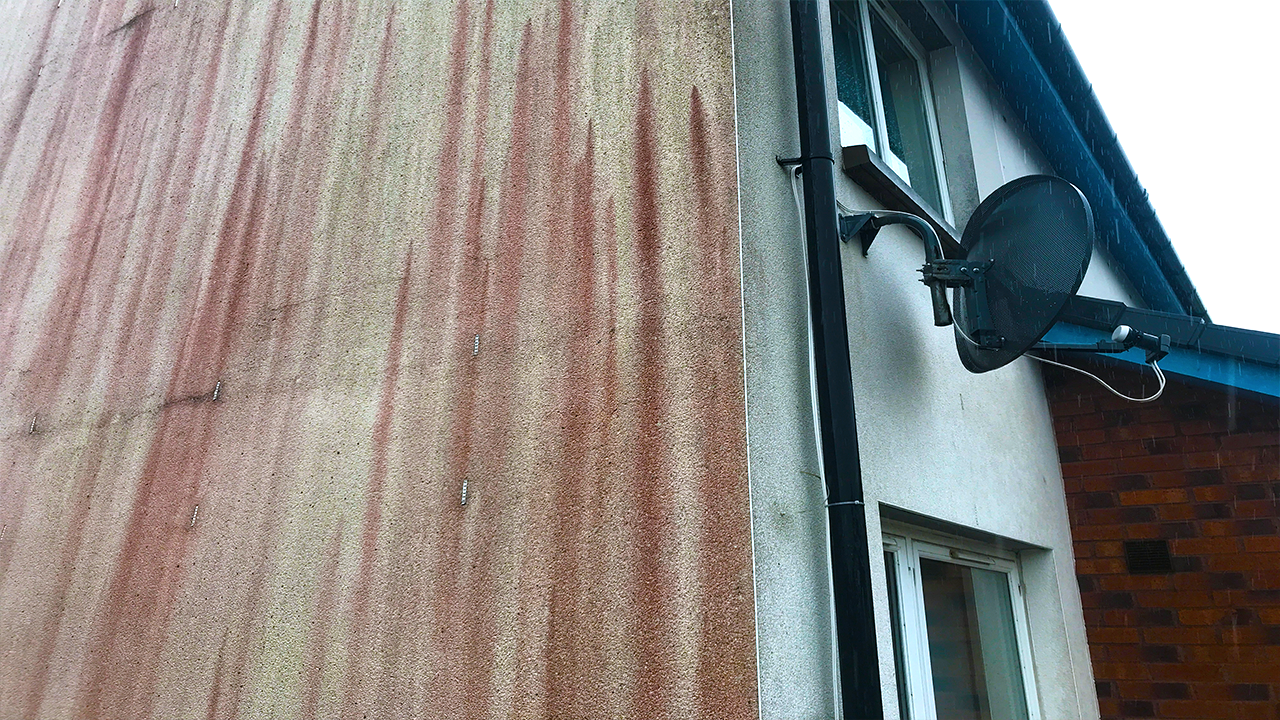
I checked a couple of my trusty defect books which had nothing which resembled the vivid red markings on the building I was faced with. I spoke to colleagues who mentioned that it was blockwork construction, so that blew my common brick staining theory out of the water.
I then decided to refer my problem to the internet and google the term ‘red staining on render’ and the image results pulled up a number of similar looking defects on buildings which were down to ‘red algae’. A specialist cleaning firm based in Ireland shows many examples of red algae on its social media pages.
What is Red Algae
Fabio Rindi and Michael D. Guiry (2002) identified five members of the Trentepohlia family in Galway, one of them being ‘red algae’. They noted that in western Ireland it is very common on concrete walls both bare and painted. It forms deep red patches with the appearance of irregular vertical stripes and can grow to cover many metres of the wall surface. Trentepohlia is a species of green algae which produces haematochrome which is a red biological pigment, for simplicity I will refer to it throughout this blog as red algae.
Red algae (Trentepohlia iolithus) can be found in cold and humid conditions, with its best conditions for growth based on laboratory tests were between 10 - 20 degrees. It is often found in Europe on rocks, walls and tree bark and as I found out the west of Scotland on rendered walls. Once you understand what it is it becomes very easily recognisable even from a distance as it is so distinctive.
A 2013 trade article on the ‘Colonisation of surfaces’ stated the following “A biofilm forms when certain microorganisms adhere to the surface of some object in a moist environment and begin to reproduce. Biofilm formation on surfaces usually starts with phototrophic organisms (algae, cyanobacteria) which use carbon dioxide (CO2) from the atmosphere and sunlight as their carbon and energy source.”
Whilst the coating of algae on the surface of a render does not look likely to cause any structural damage it does certainly spoil the appearance of the surface and will lead to tenant complaints as I found out.
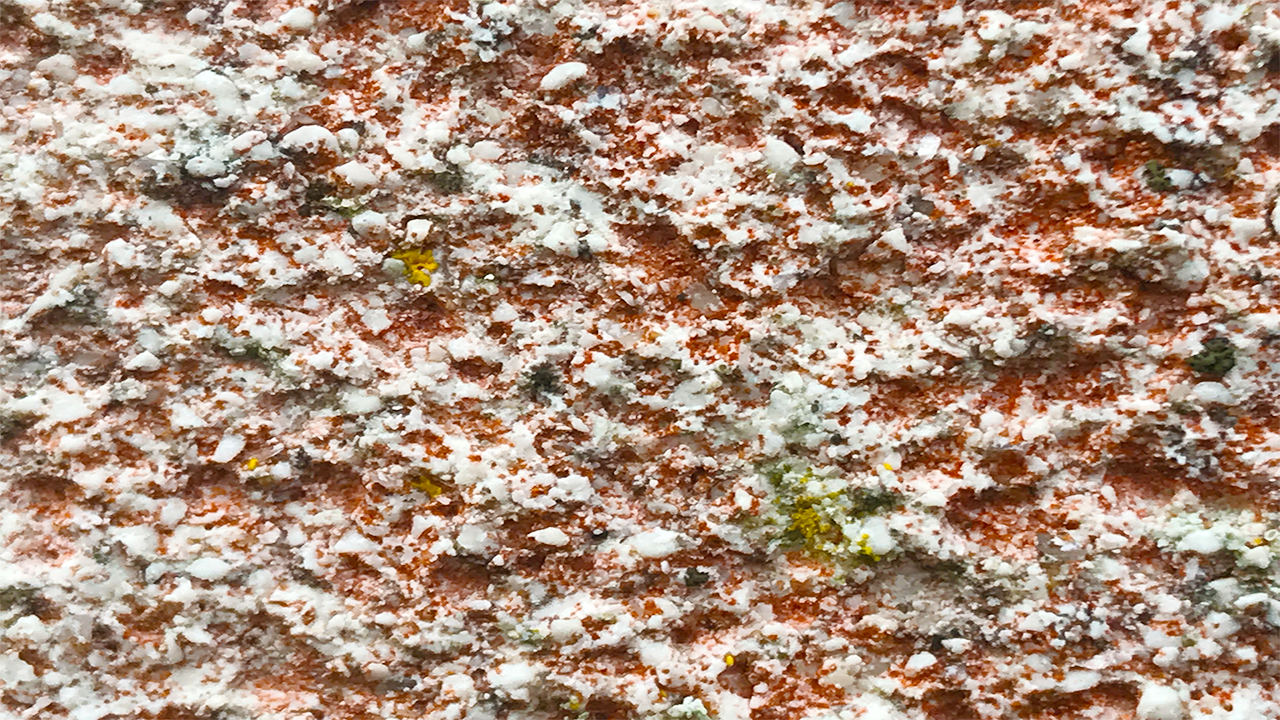
On close inspection, you can see encrustations of yellow and green algae with the predominant red toned algae throughout.
Removal of Red Algae
As far as I can tell there are two main methods of removing and cleaning away red algae which are as follows:
- low-pressure application of a specialist biocide
- low-pressure high-temperature steam
The DOFF steam cleaning system (the current model is the DOFFIII) is a specialist bit of kit which can be used for high-temperature cleaning. No harsh pressure or chemicals are used to clean the substrate when using this system and therefore is unlikely to cause damage. The steam will remove the algae and other biological matter whilst also killing off any spores. This means there’s then no need to use a chemical biocide during the removal process. The DOFF is widely accepted for heritage work and is often specified on listed buildings, which is a good indication of its safety for use on heritage stock, but always check with the conservation officer first. Be aware that “Doff” gets used loosely for any steam cleaner. The manufacturer runs an approved contractor scheme, so ask the contractor to show they are using a genuine machine and trained operatives.
AlgoClear Pro is a product if you are looking for a biocide option. After application, the red algae dies off very quickly but some discolouration can linger for a few days. Usually, the self-cleansing is complete within 10 days. Rinsing with fresh water at low pressure will complete the decontamination. The non-aggressive high purity biocide can be used with telescopic attachments so it could save money with scaffold / cherrypickers using this method. Always follow the current manufacturer’s data sheet for dilution, spray pressure and weather conditions.
After speaking to a building cleaning specialist I also learned that in addition to DOFF, there is ThermaTech, TORC, and Karcher who also have machines that would be up to the task of effectively cleaning render. There are also other biocides available, for example Benz Softwash’s biocide. Ensuring the cleaning method adopted is suitable for the substrate is very important as using a high-temperature steam cleaner on resin or acrylic bonded render may damage the finish.
If you are in Scotland and dealing with historic masonry rather than modern render, Historic Environment Scotland’s guidance (TAN 10, Biological Growths on Sandstone Buildings) is worth a read. Their advice is that growth should only be removed from historic stone where it is shown to be causing damage, cleaning purely for appearance is not encouraged, and consent is normally needed for listed buildings and conservation areas.
AlgoClear Test Case
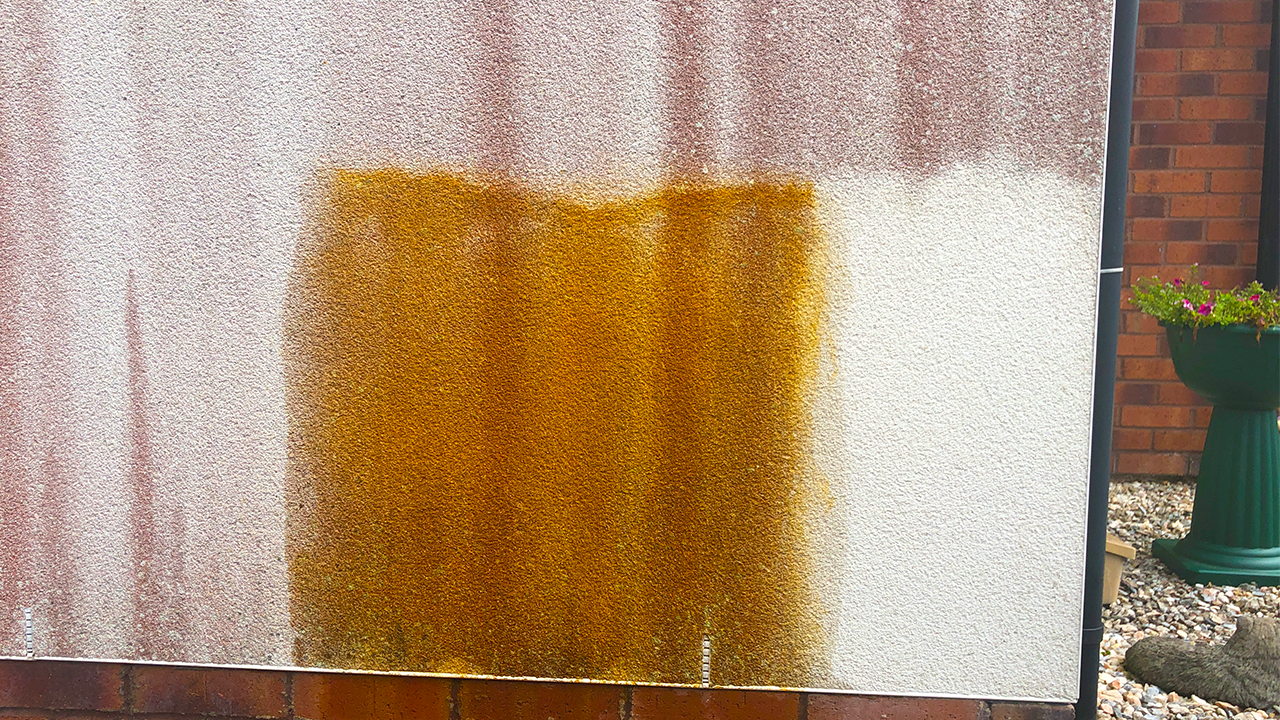
AlgoClear works excellently to remove red algae, as you can see from above. On the right-hand side is a small patch that has been treated. The deep rust coloured patch has just been treated and the rest of the wall is yet to be treated.
The treatment is sprayed on to the surface, giving it a good soaking, some brushing might be required where the biofilm is old and particularly stubborn.
AlgoClear penetrates the microorganisms cell walls without interacting with the mineral components of the render. This means no damage or discolouration to the render itself. I am told by the AlgoClear rep that the product also neutralises when it comes into contact with soil or enters the drainage. On porous render, it will decontaminate deep into the surface porosity by capillary action.
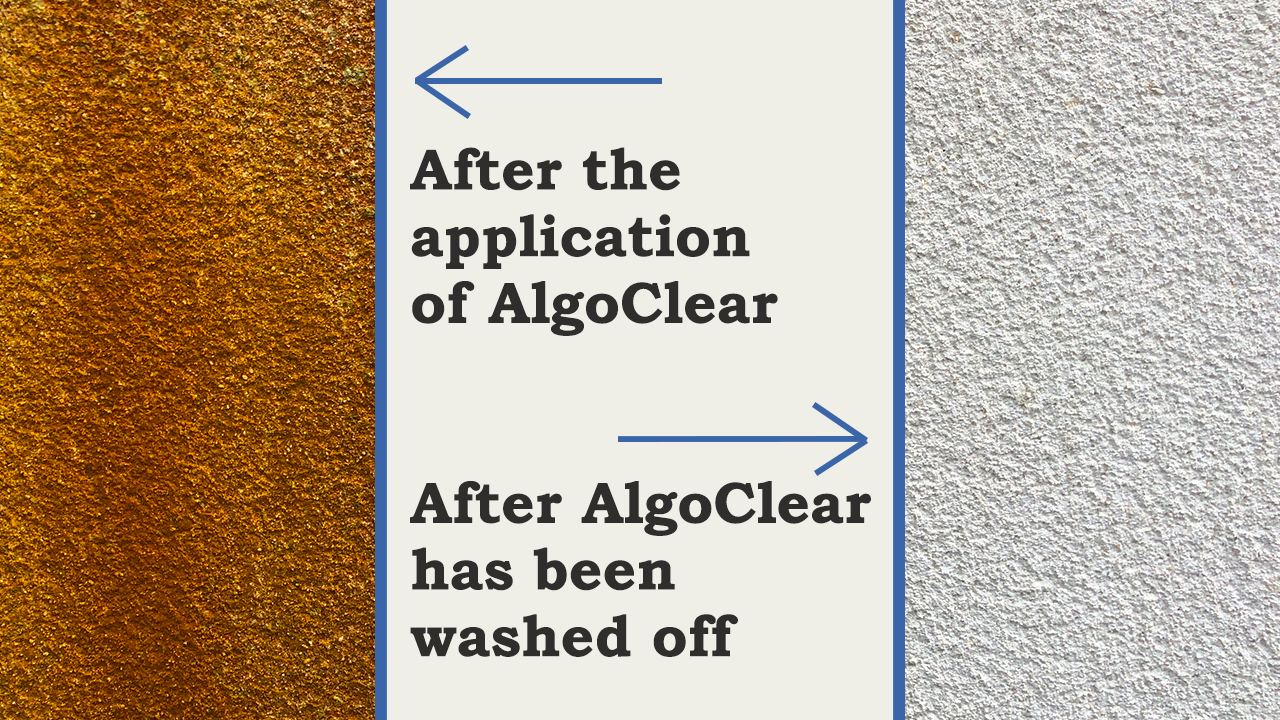
The red algae dies off at the root and will leave a coating on the surface until rain naturally cleans off the wall. If it is a particularly dry spell, a sensible option would be to follow up and clean down the walls to remove the residue. The sun will naturally oxidise remaining traces into water-soluble compounds.
The main issue that arises is that the wall will look worse before it looks better. The algae immediately dies off when the AlgoClear is applied and leaves an instant deep colour. This can startle tenants who may be concerned that the treatment has not worked. The key here is discussing the treatment beforehand with tenants via consultation or by a letter with a clear illustration showing how the treatment works.
AlgoClear can be applied using an extended pole, so this should be a cheaper method to ones that require scaffolding. AlgoClear does not contain any bleaches or ingredients that can harm window sealants or PVC beading. The finished result is really quite impressive and will make a low-cost high impact improvement to the aesthetics of the estate.
Conclusion
The issue of red algae is certainly more prevalent in western Ireland but is certainly an issue that can affect the west of Scotland as well. It is very easy to spot once you have a baseline understanding of what it is. It seems to be a fairly common issue with smooth pre-mixed silicone rendered finishes, to the point where one of the leading manufacturers, K Rend, recommends treating algae with a biocide (they now sell their own, Algae Clean), and AlgoClear is also widely used on render.
There are various cleaning options available for this aesthetic nuisance which don’t have to break the bank and will keep tenants satisfied about the appearance of their properties.